 Just About Watches


Now, I’ll say this up front—no two movements are the same. Every manufacturer has its own approach, every calibre its own personality, and every complication its own way of complicating things further. Some are robust and functional, built for the field and the sea; others are finely tuned works of mechanical poetry that demand respect and regular care. But before you can fully appreciate those differences, you need to understand the shared anatomy—the bones, ligaments and sinews of the wristwatch that have evolved through generations of horological trial, error, and refinement. What follows isn’t a sales pitch, nor a technical manual, but rather a brief guided exploration into what makes a mechanical watch alive. Think of it as a conversation between us and time itself, where each component has a voice in the chorus. I’ll no doubt dive into specific movements in later pieces, dissecting calibres and explaining what makes them special, but for now, this is your grounding—a slow, methodical walk through the anatomy of a mechanical wristwatch, from the outside in.
“A watch is a whisper from time itself. A silent reminder that every fleeting second holds the weight of memory, the promise of purpose, and the beauty of now.”
-Kev Green
To understand that whisper, you have to begin with its skin—the case. The case is more than just a container. It’s the armour that shelters precision. It defines the personality of a watch long before you even glance at the dial. Whether it’s brushed steel, polished titanium, ceramic, bronze, or a precious metal like gold or platinum, the case determines how a watch feels on the wrist, how it catches the light, and how it ages. Steel develops character through scratches and scuffs. Titanium is light and strong, resisting corrosion and temperature shifts, although its slightly darker hue lends it a technical charm. Bronze forms a patina that’s as individual as its owner, while ceramic stands defiantly against the years, its surface smooth and unyielding. Beyond aesthetics, the case is also a testament to engineering. The seals, gaskets, and joints decide how well the watch stands up to water, dust, and the occasional unplanned encounter with a doorframe.

A diver’s case, for example, is built with compression in mind. Its screw-down crown and caseback, thick crystal, and reinforced gaskets are designed to withstand the invisible pressure of the deep, while a dress watch may rely on elegance rather than fortitude, offering resistance enough for rain and nothing more. Even the geometry of the case matters: lugs are angled to balance weight and comfort, while mid-cases are machined to accommodate gaskets with tolerances so tight they often measure in microns.
Just above it, gleaming in the light, is the crystal—the transparent shield that protects the dial while offering a clear view of the world beneath. Not all crystals are equal, and not all are even made of what we’d traditionally call glass. Acrylic, mineral, and sapphire are the three main choices, each with its quirks and strengths. Acrylic, or hesalite as Omega famously called it, is soft, forgiving, and surprisingly warm to look through. It scratches easily but can be polished back to clarity with nothing more than a dab of paste and a patient hand. Mineral glass, on the other hand, is harder, more resistant to everyday scuffs, but when it does scratch, it stays scratched. Sapphire sits proudly at the top of the hierarchy—artificially grown through a process known as the Verneuil method, heated and crystallised into near-perfect clarity, and polished until it becomes optically pure.
Measuring nine on the Mohs scale of hardness, sapphire is almost impervious to scratches and often treated with anti-reflective coatings, sometimes on both sides to eliminate glare. That coating itself is a fine layer of magnesium fluoride or similar material, vapour-deposited in a vacuum chamber. But sapphire’s rigidity is both its strength and weakness—it resists scratches but can shatter under a sharp impact, especially along its edges. The choice of crystal tells you something about the watchmaker’s priorities—durability, serviceability, or luxury. And no matter which you have, it’s more than a window. It’s a pressure boundary, a critical structural element in maintaining water resistance. A single flaw in the fit, or a misaligned gasket, and moisture will find its way in. A watchmaker once told me that water always wins—it just depends on how long the fight lasts.
Framing that crystal is the bezel, and this is where practicality meets design. Some bezels are fixed, others rotate. A unidirectional rotating bezel is an essential tool for divers, allowing them to monitor oxygen supply safely without the risk of accidental extension. Its clicks are produced by a ratchet spring beneath the surface—each tooth engaging precisely to offer tactile feedback and mechanical security. Pilots and travellers prefer bidirectional bezels for speed in adjusting time zones or calculating flight intervals. Many GMT watches incorporate a 24-hour scale on the bezel itself, often made from ceramic or anodised aluminium, where colour contrasts indicate day and night. The tolerances here are incredibly fine; a bezel that’s too loose will wobble, one that’s too tight will bind. The bezel assembly also includes gaskets and, in some designs, even a retention wire that allows easy removal during servicing. It’s often the most exposed part of the watch, constantly meeting the world through bumps and scrapes, yet it’s engineered to stay functional through years of use. In tool watches, the bezel is a vital partner. In dress pieces, it’s a frame for artistry. In either form, it’s the bridge between beauty and purpose.
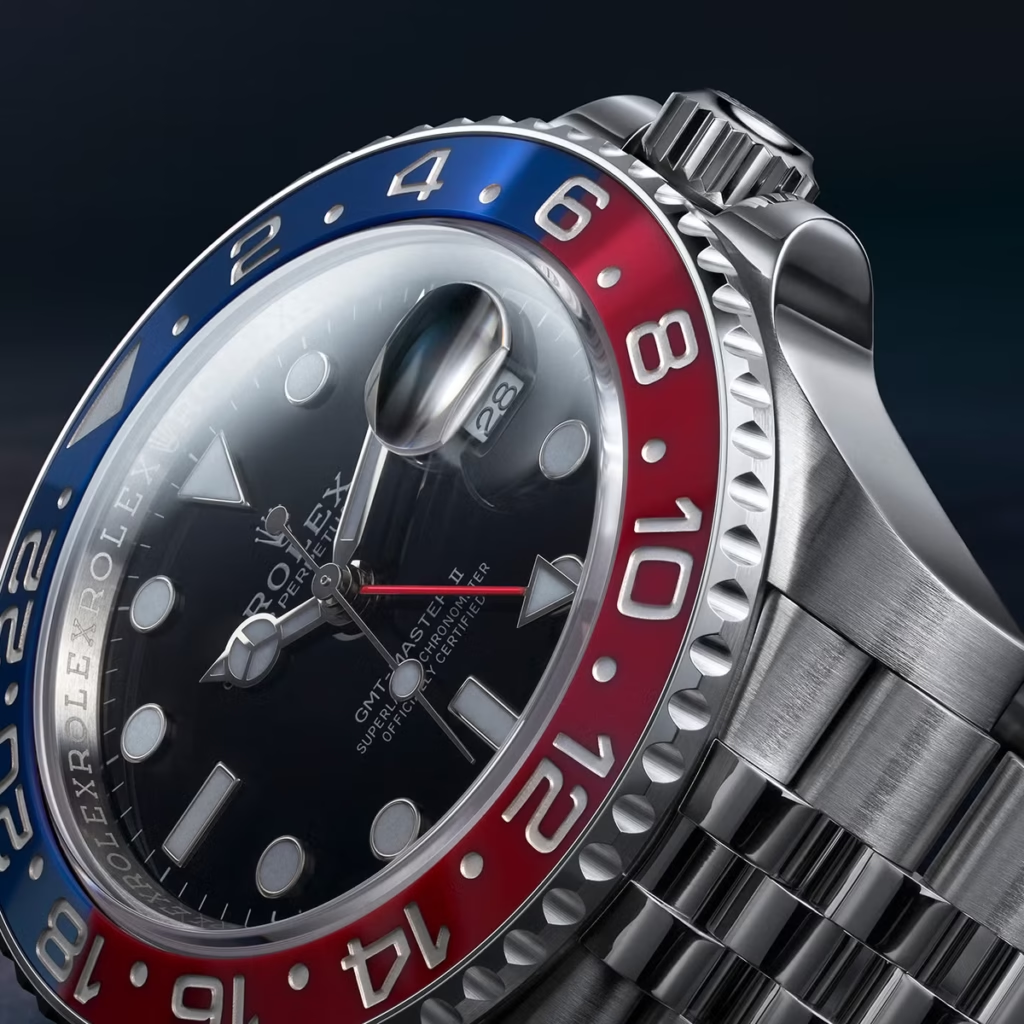
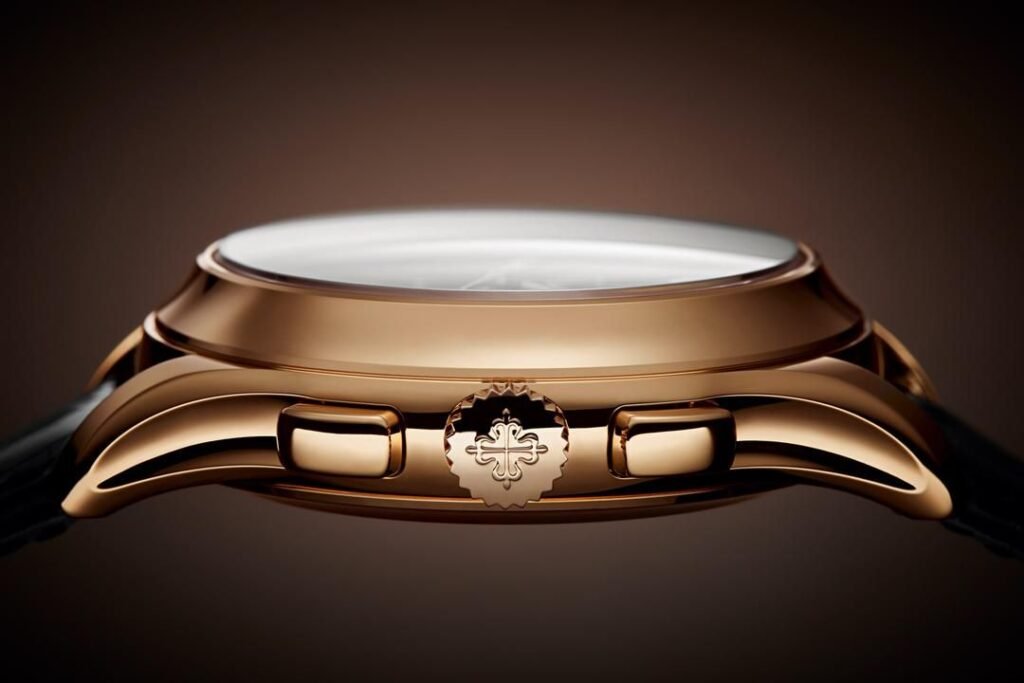
Then comes the crown, perhaps the most personal element of all. The crown is where human meets mechanism—your fingertips turning tension into motion. You wind the mainspring through it, adjust the hands, and, depending on the calibre, control the date, moon-phase, or even a second time zone. It might be fluted for grip, engraved for decoration, or fitted with rubber seals to resist moisture. A screw-down crown adds another layer of protection, threading tightly against the case tube to form a watertight barrier, often reinforced with O-rings. The tolerances are microscopic, requiring perfect alignment to avoid cross-threading. Inside, a complex miniature system known as the keyless works translates the crown’s movement into function. Pulling it out to the first position might engage a quickset date mechanism via a sliding pinion; a further pull might shift a setting lever that connects to the motion works, allowing you to adjust the hands. Every action is governed by friction springs, levers, and tiny yokes—all designed to provide that satisfying click or gentle resistance when the job is done. Even the stem that connects the crown to the movement is finely hardened steel, sometimes treated to resist corrosion.
Flip the watch over, and you reach the caseback. For many, it’s the unsung hero of the entire assembly. It seals the watch from beneath, holds the movement in place, and provides a surface for identity—serial numbers, model designations, depth ratings, and often, artistry. Some casebacks are solid, made of the same metal as the case, engraved or embossed with the brand’s emblem or heritage markings. Others are exhibition-style, fitted with sapphire glass to showcase the movement inside. The sapphire is often glued or press-fitted into a metal ring to maintain structural strength, and like the front crystal, it too must bear pressure and temperature changes without cracking. Casebacks are usually secured by screws or threads, each type offering different advantages. Screw-down backs provide the best water resistance; snap-backs are easier to open but weaker under pressure. Some watches, particularly chronographs, even employ multiple gaskets around the perimeter to ensure reliability during active wear.
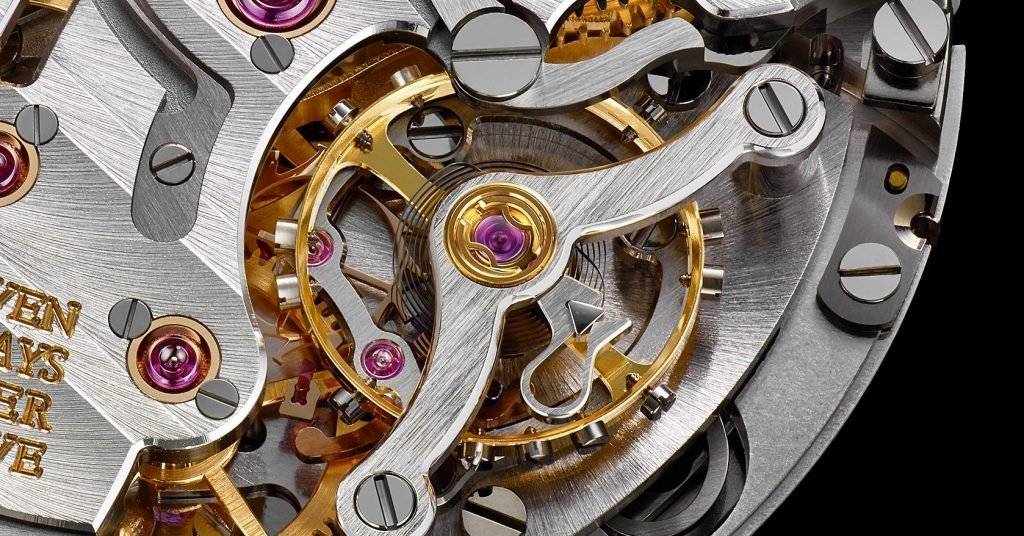
Beneath it lies the movement—the heart, the soul, and the science. Every mechanical movement is a small miracle of controlled energy. The mainspring, coiled inside a barrel, stores the watch’s power. A full wind might give anywhere from 36 to over 100 hours of reserve, depending on the calibre. As it unwinds, torque travels through the gear train: the centre wheel (usually turning once per hour), third wheel, fourth wheel (driving the seconds hand), and finally, the escape wheel. Each tooth in this train is designed to specific angles to reduce friction, while jewels—synthetic rubies—act as bearings to minimise wear. The escapement, a delicate assembly of the escape wheel, pallet fork, and balance wheel, regulates the release of this stored energy into rhythmic beats. The balance wheel oscillates back and forth, usually between 18,000 and 36,000 vibrations per hour, depending on the movement’s design. Its companion, the hairspring, breathes with each swing, expanding and contracting with perfect elasticity, its length and stiffness determining the watch’s precision.
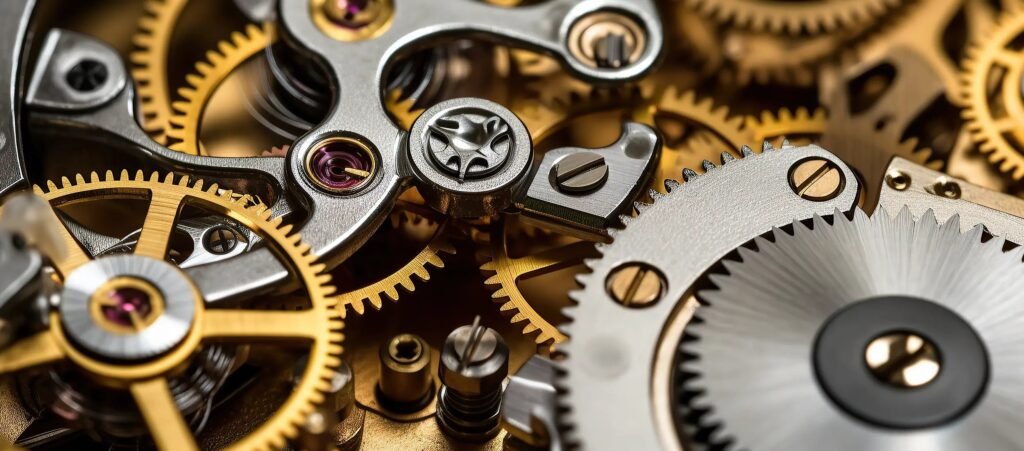
Many modern movements employ an anti-shock system, such as Incabloc or KIF, using small springs to protect the balance staff pivots from sudden impact. Some use silicon hairsprings, unaffected by magnetism and temperature changes, offering better long-term stability. The rotor in an automatic watch—a half-moon-shaped mass mounted on ball bearings—spins with wrist motion, winding the mainspring through a ratcheting system of reverser gears. In some calibres, the rotor winds in one direction only; in others, both. And though it seems effortless, the efficiency of that winding system depends on the geometry of its reduction wheels, the lubrication of its jewels, and even the shape of its pivots.
Decorations within movements are not mere vanity. Anglage, perlage, and Geneva stripes serve both aesthetic and functional purposes, reducing corrosion and highlighting craftsmanship. Screws may be blued through controlled heating, an old tradition that both beautifies and hardens them. Bridges might be bevelled, plates rhodium-plated or gilt. In high-end pieces, adjustments are made in multiple positions and temperatures, ensuring that gravity, posture, and climate have minimal influence on timekeeping. Even the lubricant—synthetic oils that must withstand years of micro-motion without drying or migrating—is a science of its own. Too much, and it spreads; too little, and friction devours precision.
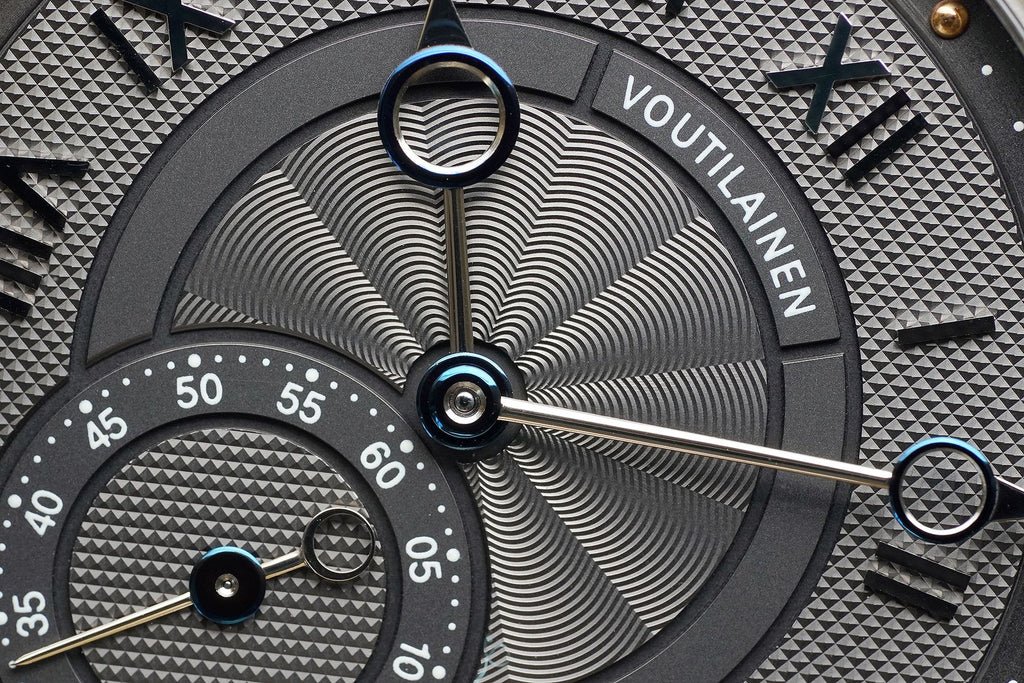
The dial and hands form the bridge between mechanism and human perception. Beneath the dial lie the motion works—a reduction gear system that translates the minute wheel’s rotation into that of the hour hand, maintaining their exact ratio of twelve to one. Luminous compounds, once radium and later tritium, now Super-LumiNova, are carefully applied to the indices and hands, activated by light and glowing in the dark to ensure legibility. Even printing on the dial involves precision—tampography deposits ink in layers measured in microns. Some dials feature applied indices fixed with tiny feet through the plate, others are printed directly. Guilloché patterns are cut by rose engines, enamel is fired at temperatures above 800°C, and meteorite dials are sliced from iron-nickel fragments that predate humanity itself.
When you next hold a watch, take a moment to think of all of this—the fine mesh of materials, geometry, chemistry, and artistry that makes it possible. Feel the balance between resistance and compliance as you turn the crown. Notice the clarity of the crystal, the way the case’s geometry hugs your wrist, and the whisper of the rotor if you listen closely. Each detail is the product of centuries of incremental perfection, from the mainspring invented in the 15th century to the silicon escapements of today. Watches are, in essence, our oldest form of wearable technology, and still our most poetic.
So if you’re going to call yourself a watch lover, understand what beats beneath the surface. Because when you grasp how tension becomes motion, and motion becomes time, you begin to see your watches not as possessions, but as companions—machines that mirror the rhythm of your life. Each turn of the crown winds not just a spring, but the continuity between craftsmanship and curiosity. And every second that passes on your wrist isn’t merely measured—it’s shared.
If you strip a mechanical watch down to its skeleton, what you’re left with is a network of components all designed to serve one purpose—precision through balance. But balance doesn’t happen by accident. Every tooth of every gear is cut to an exact shape known as an involute profile, ensuring constant velocity transmission between wheels. That’s why a well-made watch doesn’t just tick consistently—it breathes rhythmically, like a living organism. The pivot points of these wheels rotate inside synthetic ruby bearings not only for durability, but to prevent metal-on-metal contact. A typical higher-end movement might contain anywhere from seventeen to thirty-one jewels, depending on the number of complications. The jewels themselves are friction-fit or secured by chatons, some even pressed into shock-absorbing springs to protect the most delicate parts from the jolts of everyday life. When you think about it, that tiny jewel setting in the escapement does more to preserve accuracy than most of us give credit for.
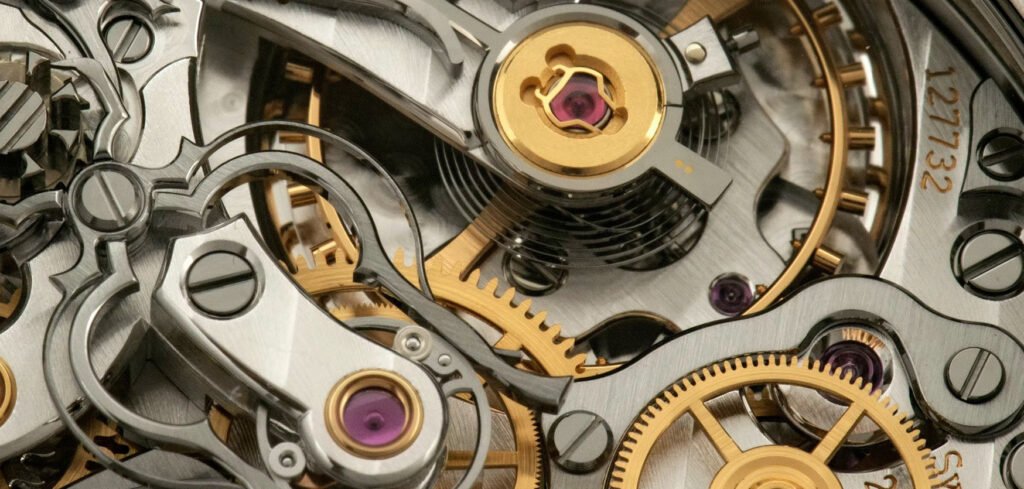
Lubrication plays a similarly unsung role. A mechanical movement may use half a dozen different lubricants, each with a specific viscosity and chemical formulation suited to its location. Thick grease goes where torque is highest—at the barrel arbor, for example—while light synthetic oil is used on the escapement to minimise drag without interfering with impulse. Some modern calibres, especially those employing silicon components, require no lubrication at all in critical areas, thanks to silicon’s natural smoothness and lack of magnetic susceptibility. Even so, oiling a watch is a delicate balance between sufficiency and excess. Too little, and friction builds until parts wear or seize; too much, and the oil spreads through capillary action, pooling where it shouldn’t and causing rate instability. The act of oiling a jewel, done under magnification, involves touching a drop of oil smaller than a pinhead onto the pivot using a fine oiler. Get that wrong, and a watch that should run within seconds a day might drift into minutes. It’s an art form disguised as maintenance.
Regulation, too, is far more complex than the layperson realises. Once a watch is assembled, its balance spring must be adjusted to ensure that the oscillations remain consistent across all positions—dial up, dial down, crown left, crown up, crown down, and crown right. This process, called positional regulation, compensates for gravity’s varying effect on the balance amplitude. Watchmakers use timing machines that ‘listen’ to the beat error and rate deviation, adjusting the regulator or balance screws to achieve perfection. Higher-end watches might even feature a free-sprung balance, where there’s no regulator at all—timing is achieved by altering the inertia of the balance wheel itself via micro screws or gold weights. This setup is more stable over time but requires an expert hand to adjust. Some calibres also include a swan-neck fine regulator, allowing micro-metric control over the spring’s active length with a gentle twist of a screw. It’s mechanical artistry of the highest order, invisible to most eyes, yet fundamental to the timekeeping performance that defines a great watch.
Complications elevate the mechanical watch from a tool to a symphony. The simplest complication, the date, is achieved through a date wheel indexed by a finger attached to the hour wheel, advancing once every twenty-four hours. But beyond that lie marvels like chronographs, moonphases, perpetual calendars, and tourbillons. A chronograph, for example, adds an entire subsystem of levers, clutches, and hammers to control elapsed time, all driven by the same mainspring. Column wheel chronographs use a turret-like mechanism that coordinates the start, stop, and reset actions with silky precision, while cam-actuated chronographs are more rugged but less refined in feel. The reset hammers must land simultaneously on the heart cams of the chronograph wheels, returning them to zero in one perfectly synchronised movement.
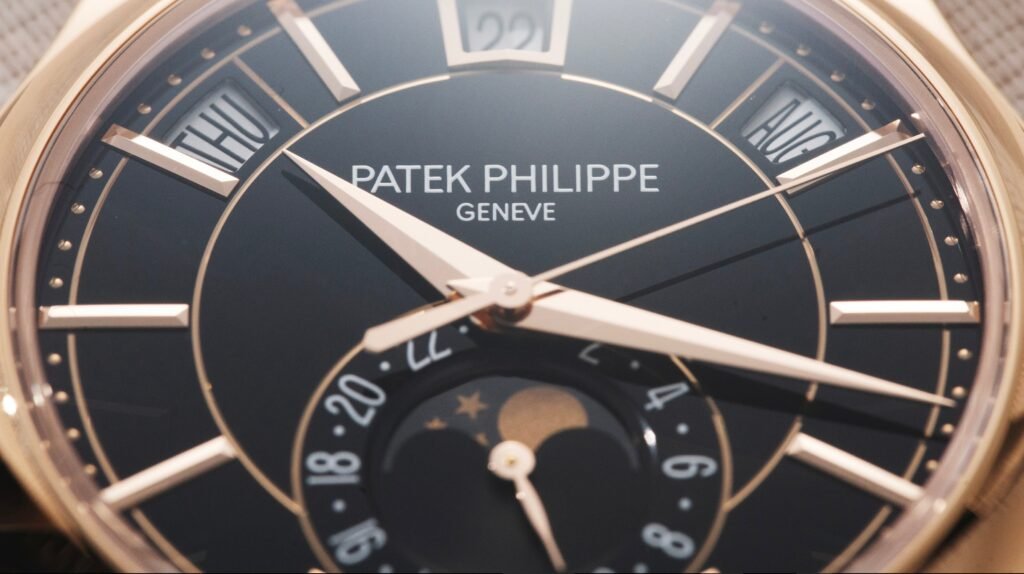
A moonphase complication, on the other hand, tracks the lunar cycle using a 59-tooth wheel, accurate to a single day in two years unless corrected. The perpetual calendar is a feat of mechanical computation, automatically accounting for the varying lengths of months and even leap years—its wheelwork cycles through four years with mathematical accuracy, powered entirely by gears and springs. And the tourbillon, devised by Abraham-Louis Breguet in 1801, remains one of horology’s most mesmerising inventions—a rotating cage that constantly averages positional errors caused by gravity. It’s more spectacle than necessity today, but its continued existence proves how deep our fascination with mechanical perfection runs.
Beyond the movement’s visible function, what’s truly mesmerising is how watchmakers test and certify these creations. Swiss chronometer certification by COSC, for instance, demands an average daily rate within -4 to +6 seconds over fifteen days in five positions and three temperatures. A tiny deviation in the balance spring’s elasticity, a trace of magnetic interference, or even a change in barometric pressure can influence performance. That’s why modern high-end movements often feature silicon hairsprings, Nivachron alloys, or Parachrom Blue—materials engineered to resist magnetism and maintain stability across extreme conditions. ISO standards also play a role, particularly in divers’ watches, which undergo rigorous testing for water resistance, condensation, and shock resilience. Some brands push beyond the ISO requirements with proprietary trials—Omega’s METAS Master Chronometer certification, for example, includes exposure to 15,000 gauss magnetic fields and tightens accuracy tolerances to 0/+5 seconds per day. These aren’t just tests; they’re proof of faith in the machine.
Servicing, though, is the ultimate reality check of mechanical watch ownership. A movement’s oils dry over time, parts wear, and seals degrade. A typical service interval of three to five years isn’t arbitrary—it reflects the lifespan of the lubricants under average use. During a full overhaul, a watch is disassembled into hundreds of individual pieces, cleaned ultrasonically, inspected under magnification, reassembled, lubricated, and regulated anew. Each screw is torqued to exact tension, each jewel cleaned of debris, and each gasket replaced. The watch is then pressure-tested for water resistance, often in both vacuum and overpressure chambers. Some movements, particularly vintage ones, require parts that are no longer available, forcing skilled watchmakers to fabricate replacements by hand or adapt compatible components. It’s a delicate balance between preservation and renewal—a process that connects today’s watch owners directly to the lineage of mechanical craft stretching back centuries.
It’s easy to romanticise watches as static objects of beauty, but the truth is, they’re in constant dialogue with their environment. Magnetism, for instance, remains one of the most common modern enemies of accuracy. Constant exposure to smartphones, laptops, and even handbag clasps can magnetise a hairspring, causing coils to stick together and the watch to run wildly fast. Modern materials like silicon and Nivarox mitigate this, but demagnetising remains an essential part of watch care. Temperature variation, too, plays its part. Early watchmakers experimented with bimetallic compensation balances—rings of two metals that expand differently with heat, countering changes in spring tension. Today’s alloys handle this automatically, but the principle remains: timekeeping is a battle against the elements.
And yet, despite all the science, all the metallurgy and mathematics, what truly captivates about a mechanical watch is its soul. You can feel it through the crown as you wind it—the resistance of the mainspring tightening like a coiled promise. You can hear it faintly if you hold it close, that rhythmic pulse somewhere between a heartbeat and a whisper. It’s not digital perfection, nor should it be. It’s controlled imperfection—human mastery pushing back against the limits of physics. A quartz watch may be more accurate, but a mechanical watch feels accurate because it engages your senses and your imagination. When you wear one, you participate in its life cycle—winding, setting, observing, maintaining. It needs you as much as you need it.
Every component, from the lowly case screw to the shimmering balance wheel, tells a story of intention. Those screws are often blued at 290°C for beauty and corrosion resistance. Bridges are designed not just for structure, but to channel power and absorb shock. Even the humble dial feet are soldered with precision to ensure perfect alignment. It’s humbling to think that such an object exists on your wrist, quietly performing thousands of calculations a second, without a battery, without software, without anything more than tension and balance. So the next time you glance at your wrist, pause for a moment. Behind that serene face of hands and markers lies a world of springs and levers, jewels and oils, all conspiring to translate motion into time. Every part serves a purpose, from the tiniest click spring to the grand architecture of the mainplate. Understanding it isn’t just about technical appreciation—it’s about respect. Because a watch isn’t just a timekeeper. It’s a collaboration between human ingenuity and nature’s laws, a centuries-long conversation that still hasn’t ended.
And perhaps that’s what keeps us collecting, learning, winding, and wearing. A watch is more than metal and movement—it’s the manifestation of curiosity itself. Each second that passes on its dial is one we can never reclaim, yet somehow, knowing how it’s measured makes it feel more significant. To love watches is to love time itself, not as something fleeting, but as something worth holding, even if only for a tick. When you think about it, every mechanical watch is an experiment in endurance. Power reserves, for example, are an ongoing study in energy management. The mainspring must store enough torque to keep the escapement oscillating steadily for hours or even days, yet release that energy gradually and consistently.
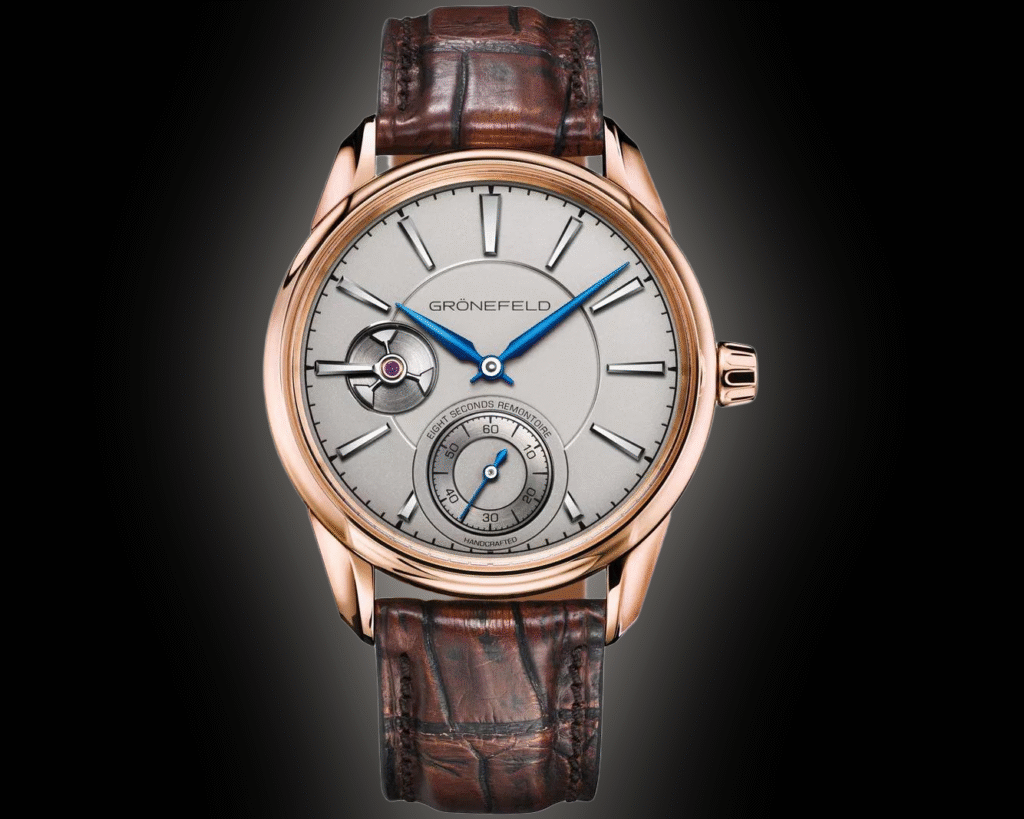
Early watches barely managed a single day of autonomy; today, with improved metallurgy and more efficient gear trains, many mechanicals comfortably run for three days or longer. Some manual wind movements even push to eight days or beyond, thanks to twin or triple barrels that unwind in sequence or parallel. But the longer the reserve, the more complex the regulation becomes. As torque drops, the amplitude of the balance wheel can decline, leading to rate instability. That’s why certain high-end calibres include a constant force mechanism—such as a remontoire d’égalité—to deliver uniform energy to the escapement regardless of the barrel’s tension. It’s the kind of engineering flourish you’ll rarely see but immediately feel in the steadiness of the seconds hand.
Temperature stability, too, remains a quiet obsession in fine watchmaking. While modern alloys have largely neutralised expansion issues, the best manufacturers still test movements in climate chambers simulating arctic cold and tropical humidity. It’s not just about accuracy, but about the watch’s ability to remain functionally consistent as oils thicken or thin with temperature. Even the minute variations in balance wheel expansion are accounted for through advanced computer modelling during the design phase. Yet, no matter how modern the simulation, final testing still happens the old-fashioned way: a watchmaker winds the movement, sets it on a timing machine, and listens. There’s a poetic symmetry in that—after centuries of progress, the final arbiter of quality is still a trained human ear, attuned to the heartbeat of a machine.
Water resistance, too, isn’t simply a gasket problem. The integrity of a watch under pressure is a dance between geometry and material science. Every caseback, crown, and crystal junction must distribute stress evenly when subjected to compression. That’s why divers’ watches often feature thicker sapphire crystals and screw-down crowns with multiple O-rings, whereas dress watches rely on fine tolerances and gentle seals. The watch’s ability to survive immersion isn’t just about engineering—it’s a declaration of trust between maker and wearer. After all, when someone takes a watch to the ocean’s edge, they’re not thinking about microns of gasket elasticity; they’re thinking about the moment. That faith is something only mechanical watchmaking can truly command, because it’s built on tactile familiarity rather than theoretical assurance.
And this is where the philosophy of endurance becomes inseparable from the philosophy of ownership. A mechanical watch doesn’t just last; it persists through care, through continuity, through generations. A digital watch will one day fail because a circuit burns out or a part becomes obsolete. But a mechanical watch, given the right hands and tools, can live indefinitely. Each service renews its purpose; each worn part can be replaced or remade. There are watches ticking today whose first owners died before the light bulb was invented, and they’re still keeping time as if nothing has changed. That’s the quiet power of mechanical engineering done right—it outlasts relevance, it transcends fashion, it outlives us.
In the end, that’s perhaps what keeps me fascinated after all these years. I’ve handled more watches than I can count, owned hundreds if not thousands, and each time I open a caseback, I’m reminded that inside lies something timeless—not because it tells time, but because it resists it. The balance wheel swings just as it did in the hands of its maker, the gears turn with the same invisible rhythm that has marked human progress for centuries. Every tick is a declaration that motion still matters, that precision still holds meaning in a world that often trades both for convenience.
And so, whether your collection numbers in the dozens or the thousands, every watch deserves a moment of quiet respect. They’re not merely accessories or investments or curiosities; they’re the distilled result of centuries of human curiosity and patience. Treat them as such. Learn their temperaments, their quirks, their needs. Because behind every polished case lies a miniature universe of forces in harmony, turning tension into time and time into memory. And when all is said and done, that’s all a watch really asks of us—to be noticed, to be wound, to be worn, and to be part of the rhythm that outlasts its owner.