 Just About Watches


Wristwatches weren’t always worn on the wrist, as odd as that may sound today. In the early days until the late 19th and even early 20th century, timepieces were tucked into waistcoats, fobs, or belts—carried, not worn. To wear one on the wrist, especially as a man, was widely viewed as unnecessary and even effeminate. That changed sharply with the war.
During the Boer War, and even more profoundly during the First World War, soldiers needed to read the time quickly and without fuss. Digging around in a coat or tunic for a pocket watch wasn’t just inconvenient; it could be dangerous. The result? Soldiers began fashioning crude leather loops to tie pocket watches onto their wrists. These were the earliest forms of what we’d now call trench watches—crucial improvisations that transformed the very culture of timekeeping.

The earliest commercial wristwatches adopted fixed wire lugs to accommodate straps. They were basic, typically using pigskin or cowhide leather, and were often hand-stitched. Buckles mirrored the belt buckles of the time—practical, unrefined, and prone to cracking under moisture. But watchmakers soon realised that the strap wasn’t just a means to an end. It was part of the experience and, in many cases, the brand identity.
A strap can dress a watch up or down faster than a tailor can do the same to you.
One of the most important early developments was the deployant clasp, generally attributed to Louis Cartier in the 1910s. Unlike a traditional buckle, this design allowed the strap to fold into itself via a locking mechanism. It was neater, offered more security, and protected the leather from excess bending. Although it began as a dressier alternative to the pin buckle, deployants have since found their way into everyday sports watches, often with micro-adjust features that allow for fine-tuning throughout the day.
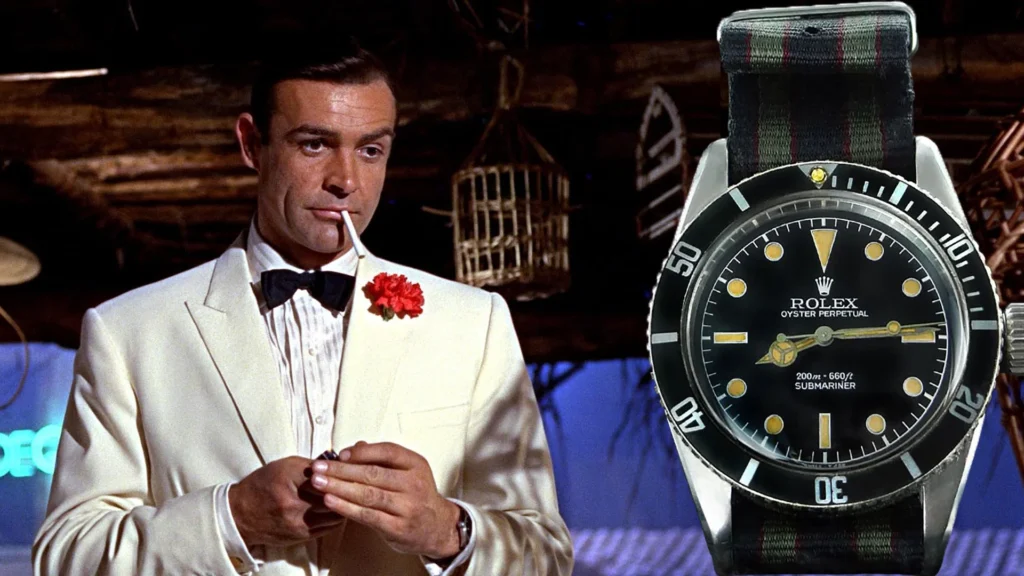
As the 20th century rolled on, the evolution of straps accelerated. During the Second World War, watches became essential military tools, and the straps had to be up to the task. Waterproofing, durability, and simplicity became paramount. This led to the eventual creation of what we now call the NATO strap—though that name is a bit of a red herring. The NATO strap was officially born in 1973 as a specification issued by the British Ministry of Defence. Known internally as the G10 strap (because of the requisition form used to order one), it was a single piece of nylon webbing that passed through both spring bars and underneath the watch case itself. This meant that if one spring bar failed, the watch would remain attached. They were cheap, rugged, easy to wash, and could be mass-produced with ease. And when Sean Connery wore a nylon strap on his Rolex Submariner in Goldfinger, the NATO—or something close to it—suddenly had pop culture appeal.
Zulu straps came later, with thicker weaves and heftier metal keepers. Paratroopers, divers, and astronauts began adapting their own strap systems—some with Velcro closures, some with multi-layered safety loops. At the same time, leather was evolving too. No longer just a workhorse material, it became a statement of class. Companies like Hirsch and Camille Fournet refined the tanning, dyeing, and stitching techniques. Horween leather from Chicago became a kind of shorthand for quality in the US. Nubuck, suede, and shell cordovan began making appearances.
But not all leathers are created equal, and this is where things get complicated. Exotic leathers—like those made from crocodile, alligator, lizard, ostrich, shark, and stingray—entered the luxury space. Some of these are beautiful and durable, no question. Stingray, known as galuchat, has a pebbled, almost beaded appearance and is among the toughest natural materials available for strap-making. The problem lies in sourcing. Many of these animals are protected under CITES, the Convention on International Trade in Endangered Species. Some farms are licensed and operate ethically, serving as by-products of the food industry. But the market has long been plagued by grey areas. A growing number of small strap sellers, particularly in Vietnam, Thailand, and parts of Indonesia, now claim to offer all sorts of exotic leathers—stingray, python, “dragonfish,” cobra skin, and so on. And while a fraction of these may be legal and responsibly sourced, many likely are not.

Enforcement of CITES varies by country, and documentation is often forged or missing altogether. When a strap made of stingray is being sold for twenty dollars on a back-alley marketplace with no proof of origin, one has to question whether it’s legitimate or whether we’re indirectly contributing to illegal wildlife trade. That said, some Vietnamese artisans are producing genuinely stunning, handmade straps from cowhide or ethically sourced water buffalo leather. It’s not all shady, but buyers do need to tread carefully.
In response to this murky corner of the strap world, the vegan movement has carved out a space of its own. Today’s vegan straps are not just cheap plastic imitations of leather. They range from high-quality polyurethane alternatives to more experimental materials like Piñatex, made from pineapple leaf fibres, and Mylo, a leather alternative grown from mushrooms. Apple peel leather is gaining ground, particularly in Europe. These options are more sustainable and appeal to a growing audience that wants luxury without harm. Durability varies, of course. Some vegan leathers hold up beautifully; others suffer under sweat or flex. But the best ones now come close to traditional leather in terms of wear, feel, and even scent.
Beyond leather and nylon, rubber has had its own journey. Early dive watches in the 1950s and 60s used basic rubber straps, which were stiff and often cracked over time. But pioneers like Isofrane developed better moulds that could resist saltwater and UV damage. Tropic rubber straps, with their perforated diamond patterns and supple feel, became classics in their own right. Modern high-end brands like Hublot, Omega, and Richard Mille have taken rubber to another level, using vulcanised and blended compounds, sometimes with inner metal cores, to provide both comfort and longevity.
Then there’s the world of metal mesh. Milanese bracelets, which date back to 19th-century Italy, blend flexibility with a polished, refined look. They’re not quite a strap, not quite a bracelet, but something elegant in between. These have experienced a renaissance lately, often appearing on Bauhaus-inspired watches and vintage reissues. Modern meshes in titanium or PVD-coated stainless steel add even more resilience.
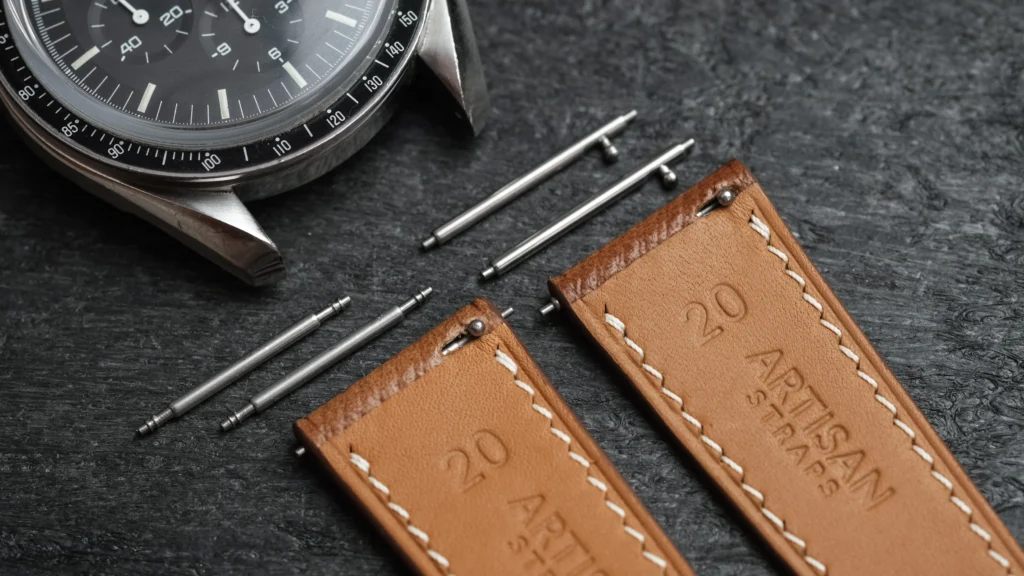
And we haven’t even touched on the technical tweaks. Quick-release spring bars are one of the best things to happen to watch enthusiasts in recent memory. No more fiddling with tools or worrying about scratched lugs—just pinch the built-in toggle and swap your strap in seconds. It encourages customisation, expands the fun, and makes even a modest watch collection feel like it has infinite variation. Curved end links, designed to follow the shape of the case rather than jutting out awkwardly, offer a more integrated, finished look. Some brands have even developed tool-free micro-adjusting clasps, letting you loosen or tighten the strap mid-day as your wrist swells or the weather changes.
Pin buckles remain the standard for most straps, beloved for their simplicity and ease of adjustment. But deployant clasps—particularly those with twin-folding arms and push-button releases—have won many fans for their ability to extend the life of a leather strap. They’re less fiddly than they once were, and when done right, almost disappear under the wrist.
Straps have played covert roles, too. During the French Resistance, some leather straps were rumoured to contain hidden compartments for microfilm or cyanide pills. In the Cold War, intelligence agents supposedly hollowed out NATO-style straps to hide coded messages. While some of these tales may have wandered into legend, they underscore the strap’s unlikely but significant presence in the margins of world history.
So, what should you wear on your wrist? That depends entirely on your watch, your wrist, and your values. Leather lends timeless elegance. Nylon gives you rugged, care-free charm. Rubber is perfect for the beach. Steel or mesh adds resilience and sophistication. Vegan options give you peace of mind. And sometimes, switching between them is half the fun.
Straps may not tick, but they tell their own time-worn stories. They’re not just accessories to the watch—they’re often historical accessories.
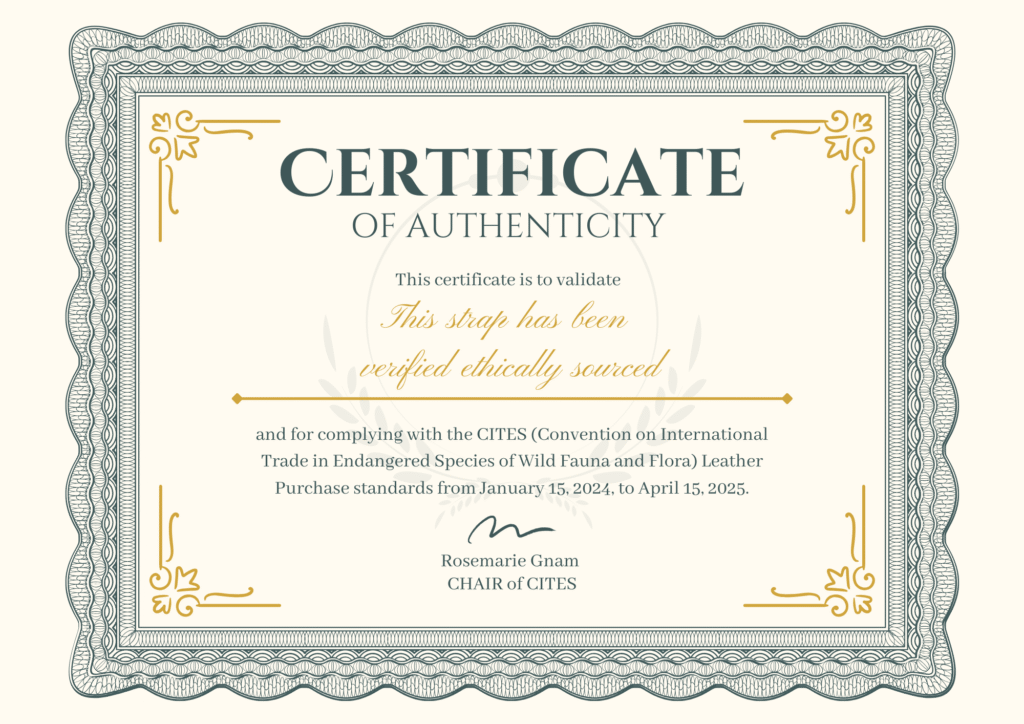
That said, the conversation around strap materials isn’t simply about preference anymore; it’s also a question of ethics and authenticity. For all the romance of alligator, stingray, ostrich, or lizard straps, we’re increasingly faced with the reality that the trade in exotic leathers isn’t as transparent as it once seemed—or rather, that it never truly was. CITES regulations (the Convention on International Trade in Endangered Species) exist to ensure traceability and sustainability, but the truth is that enforcement varies wildly from one country to another, and paperwork can be as easily forged as it is issued. When I speak to small strap-makers who buy in hides from suppliers, many admit that unless they purchase directly from certified tanneries, it’s often impossible to know for certain where the material originated. The texture may look genuine, the grain may be perfect, but documentation can sometimes be little more than a photocopied form or a convenient declaration that nobody bothers to verify.
The problem is that leather—especially exotic leather—travels a long way before it ever meets a watchmaker’s blade. Crocodile skins might be tanned in Italy, cut in France, distributed through Singapore, and finally stitched in a small workshop in England or Japan. By that point, tracing the ethical chain is near impossible. And that’s before we even consider the grey market trade in hides smuggled from regions with looser animal welfare laws, often disguised as “farm-sourced” when they’re anything but. This murkiness isn’t helped by the fact that many customers actively prefer not to ask questions. There’s an unspoken line between appreciation and ignorance: if the strap looks beautiful and smells of luxury, that’s often enough. But to me, that blind spot has always been one of the most uncomfortable truths of the trade.
There’s also the wider issue of countries where certain leathers are outright illegal. For instance, in California, the sale of alligator and crocodile leather was banned for years before being temporarily overturned, and many US states and European regions still impose restrictions on exotic species. That means some straps sold as “genuine alligator” are either imported under the radar or rebranded under misleading terms like “embossed calf.” The reality is that even the most respectable strap-makers can sometimes find themselves caught in that grey zone—not out of malice, but because the global leather supply chain is so opaque that genuine compliance can be impossible to guarantee.
For collectors, this creates an awkward paradox. We talk about heritage and craftsmanship, but the ethical story behind a strap can be as cloudy as a fogged-up crystal. And with social media amplifying everything, it’s only a matter of time before the wider community begins holding both brands and consumers to higher standards. I personally don’t believe in judging someone for choosing an exotic strap; we all appreciate fine materials and their tactile qualities. But I do believe that transparency matters. When a strap-maker openly discusses where their leather comes from, whether it’s sustainably farmed or responsibly tanned, that honesty earns far more respect than any glossy marketing ever could.
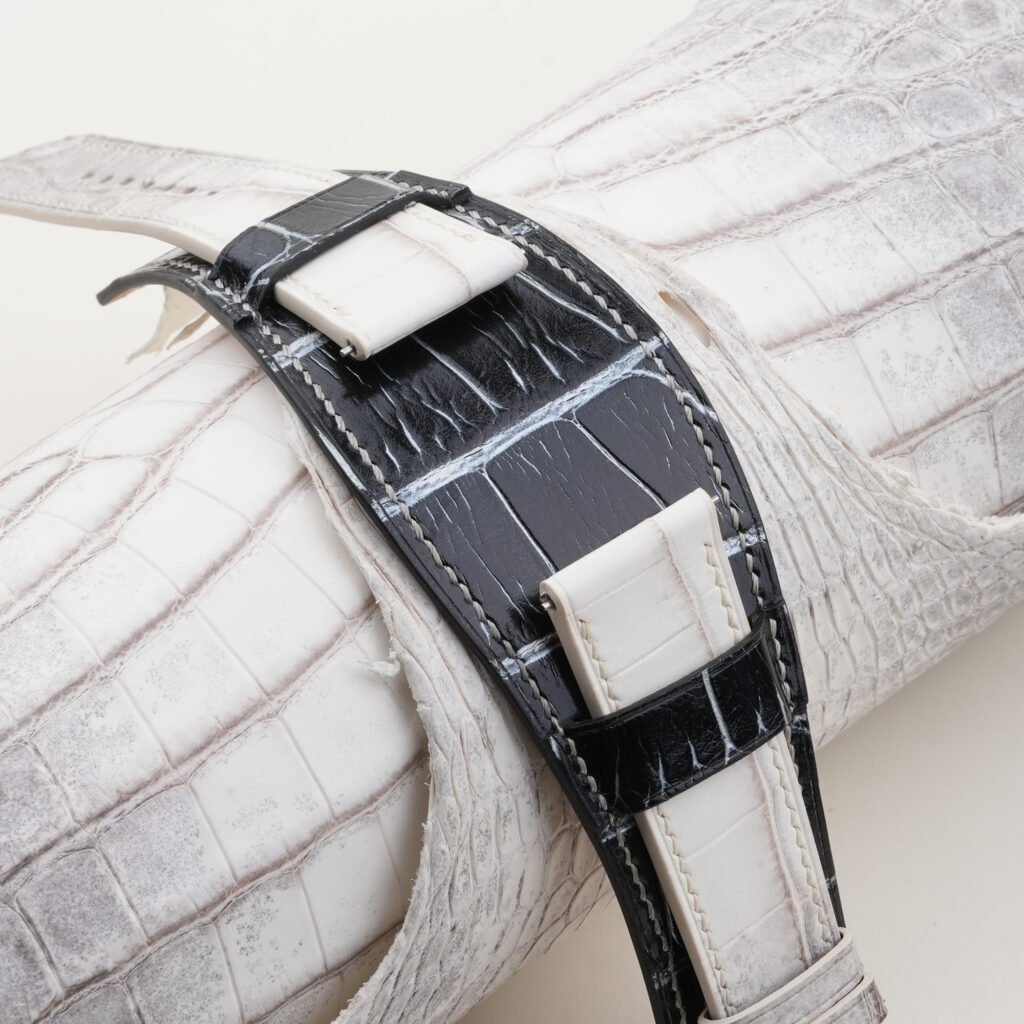
Interestingly, the rise of alternative materials has introduced a new kind of craftsmanship. Lab-grown leathers, mushroom-based materials, and plant-based polymers are now being developed with grain patterns that mimic alligator or sharkskin so closely that even seasoned collectors struggle to tell them apart. They’re not cheap imitations either; some of these sustainable leathers are produced in limited batches with the same artisanal care as traditional exotics. It’s the kind of progress that quietly redefines what luxury can be—moving it away from rarity born of scarcity, toward rarity born of ethics and innovation.
But despite these advancements, the romantic pull of real exotic leather remains strong. It’s tactile, it’s historic, and it carries the aura of old-world watchmaking. Yet, as much as I love the artistry of a perfectly matched hornback alligator strap, I can’t help but see the direction the industry is heading. In time, collectors may find themselves weighing the story behind the leather as carefully as they do the finish of a movement or the pedigree of a brand. And perhaps that’s the inevitable evolution of our hobby: an acceptance that luxury should never come at the cost of conscience.
Perhaps the future of straps rests somewhere between tradition and transformation. We’re already beginning to see it in the way collectors talk, how brands present their options, and how smaller artisans are starting to describe their craft. The next decade won’t just be about which hide or weave feels the softest; it’ll be about the story that accompanies it—the origin, the ethics, and the skill that binds it all together. I’ve spoken to strap-makers who now refuse to use any leather that isn’t fully traceable, even if it means paying two or three times more. They’d rather explain that to a client than risk being associated with questionable sourcing. That, to me, signals a genuine shift in priorities. It’s no longer enough to make something beautiful; it has to be defensible, too. And when you think about it, that’s where true craftsmanship has always lived—in integrity, not secrecy.

At the same time, technology is quietly rewriting the narrative. Companies in Italy, Japan, and Germany are experimenting with computer-controlled tanning processes that drastically reduce chemical runoff and water waste. A few are even integrating blockchain verification to prove a hide’s origin, giving each strap a sort of digital passport that follows it from farm to wrist. It sounds futuristic, but I suspect within a few years it’ll become the norm for premium strap-makers, much like COSC certification became synonymous with chronometric honesty in watches. There’s something quite poetic about that—a convergence of old-world craft and modern accountability, with both working to preserve the other.
Meanwhile, synthetic and bio-based materials are shaking off the stigma they once carried. Early attempts at vegan leather often felt too plastic, too artificial, and frankly unworthy of fine horology. But the latest iterations, made from pineapple fibre, cork composite, or mycelium (the root structure of mushrooms), are shockingly convincing. Some even age and patinate in a way reminiscent of calfskin, developing character with wear rather than cracking or peeling. I’ve handled prototypes that would fool most collectors in a blind test, and it made me realise something: maybe the future of strap-making won’t be about replacing leather, but about reimagining what it can mean. A strap that looks and feels luxurious without relying on endangered species could be the next great evolution of horological taste—a sign that refinement can coexist with responsibility.
But I also understand the resistance. There’s an emotional depth to traditional materials that’s hard to replicate. The smell of tanned hide, the feel of supple alligator on the wrist—it’s part of the ritual of collecting. I wouldn’t want to lose that any more than I’d want to see mechanical movements replaced entirely by digital ones. Yet, just as we learned to accept ceramic, titanium, and carbon composites as legitimate materials in case design, I think we’ll eventually embrace sustainable alternatives in straps without feeling like we’ve compromised. That’s the beauty of this hobby: it evolves, but it never forgets.
What I do think will fade, however, is the indifference. The days when a strap was simply an accessory, chosen purely for its texture or colour, are numbered. Future collectors will ask questions—about origin, about process, about who made it and how. They’ll expect answers too, and strap-makers who can provide them will thrive. Those who can’t—or won’t—will slowly be left behind. In a way, that’s poetic justice. The industry that once operated behind closed doors is being gently pulled into the light, and I, for one, think that’s healthy. Transparency doesn’t diminish craftsmanship; it elevates it.
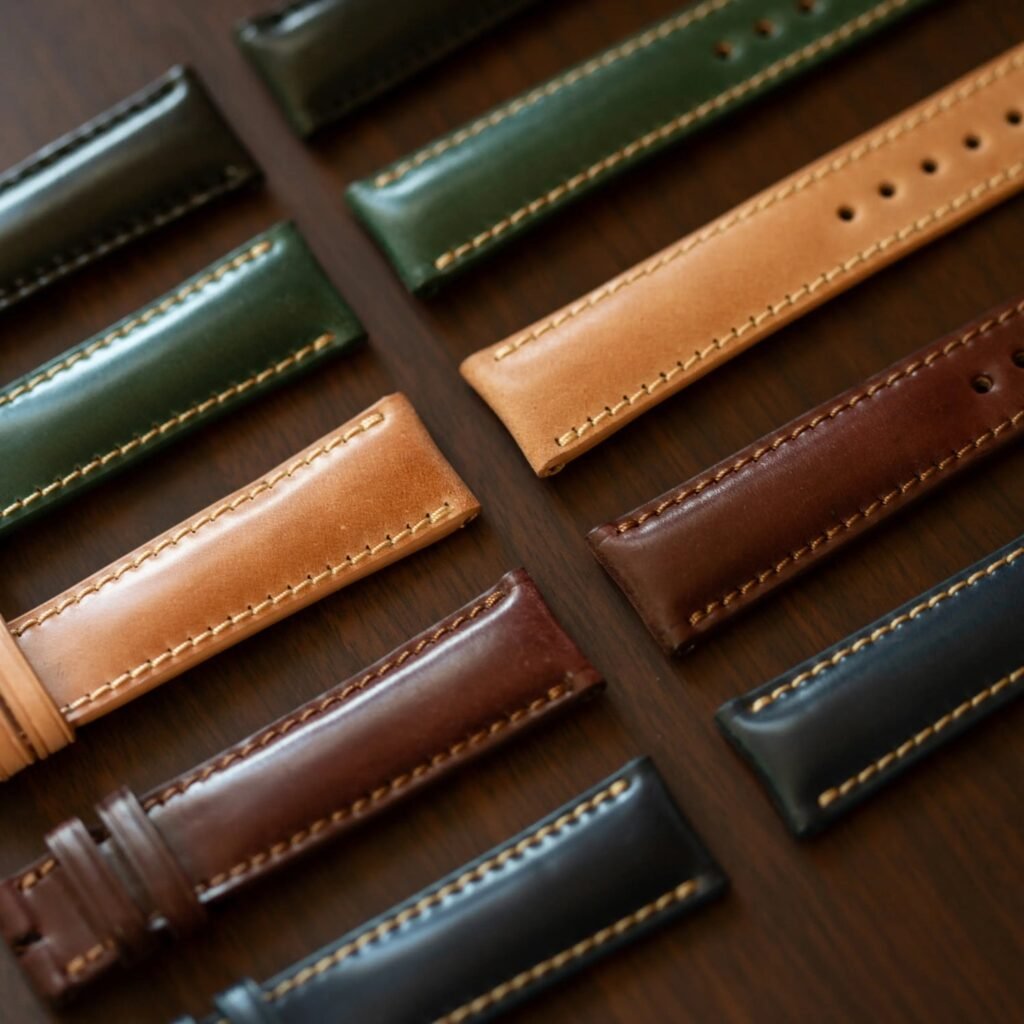
As for me, I’ll continue to admire a beautifully stitched alligator strap just as much as I’ll celebrate a hand-dyed vegan alternative that took weeks to perfect. Both tell a story of dedication, artistry, and an appreciation for detail. And in the end, isn’t that what horology has always been about? It’s never just the material itself, but the care and conviction that transform it into something meaningful. Whether that comes from the scales of an ancient creature or the fibres of a living plant is, perhaps, less important than the fact that the person who made it did so with pride. And as long as that remains true, the strap—like the watch it holds—will always have a soul.
Coming Soon: A discussion on the evolution of bracelets, buckles and clasps.